Keynotes, executive roundtables and practical workshops with Bandar Alsharfi.
What changes in the business when the AI goes live?
A successful demonstration creates interest. A working system creates a different set of questions. What outcome improves? What is that improvement worth? Whose work changes? Who accepts the risk? What evidence would justify the next investment?
I help business leaders turn strategic priorities into AI capabilities that improve decisions, create measurable value, and change how work gets done.
Start with your audience and the decision or challenge they face. Email info@codedebate.com.
My perspective comes from over 25 years building and deploying software in highly regulated environments, and hands-on AI design, implementation and operations since 2014 for very large companies. It also comes from business ownership and board responsibility: I am a cofounder and board member of ntam Group, whose operating businesses employ more than 500 people across the United States, Europe, the Middle East and Africa.
Bring a business-function leader deciding where AI can make a difference, a leadership team weighing an investment, or a working group preparing to change a workflow. We will shape the session around the decisions and working outputs that matter to them.
Start with the business decision
For leaders in strategic insights, strategy, commercial excellence, marketing, medical affairs, operations and customer experience: the people who commission AI capabilities and rely on them to deliver their function’s outcomes.
Which decisions does your function exist to improve? Where is evidence arriving too late, knowledge being recreated, or a promising pilot failing to change the work? Start there, then determine the capability needed and the role AI can usefully play.
For an insights leader, producing a report faster is one possible improvement. The larger opportunity is connecting evidence to a decision: what someone needs to know, whether they can trust it, when they need it, and what they can do differently because of it.
Working outputs: a map of decisions, users, evidence and bottlenecks; prioritized AI opportunities linked to business outcomes; a capability and adoption plan with owners and dependencies; and a scoped experiment with success and stop criteria.
We connect the business sponsor’s priorities with the delivery team, finance, people leaders and governance so that the proposal can be funded, implemented, used and evaluated.
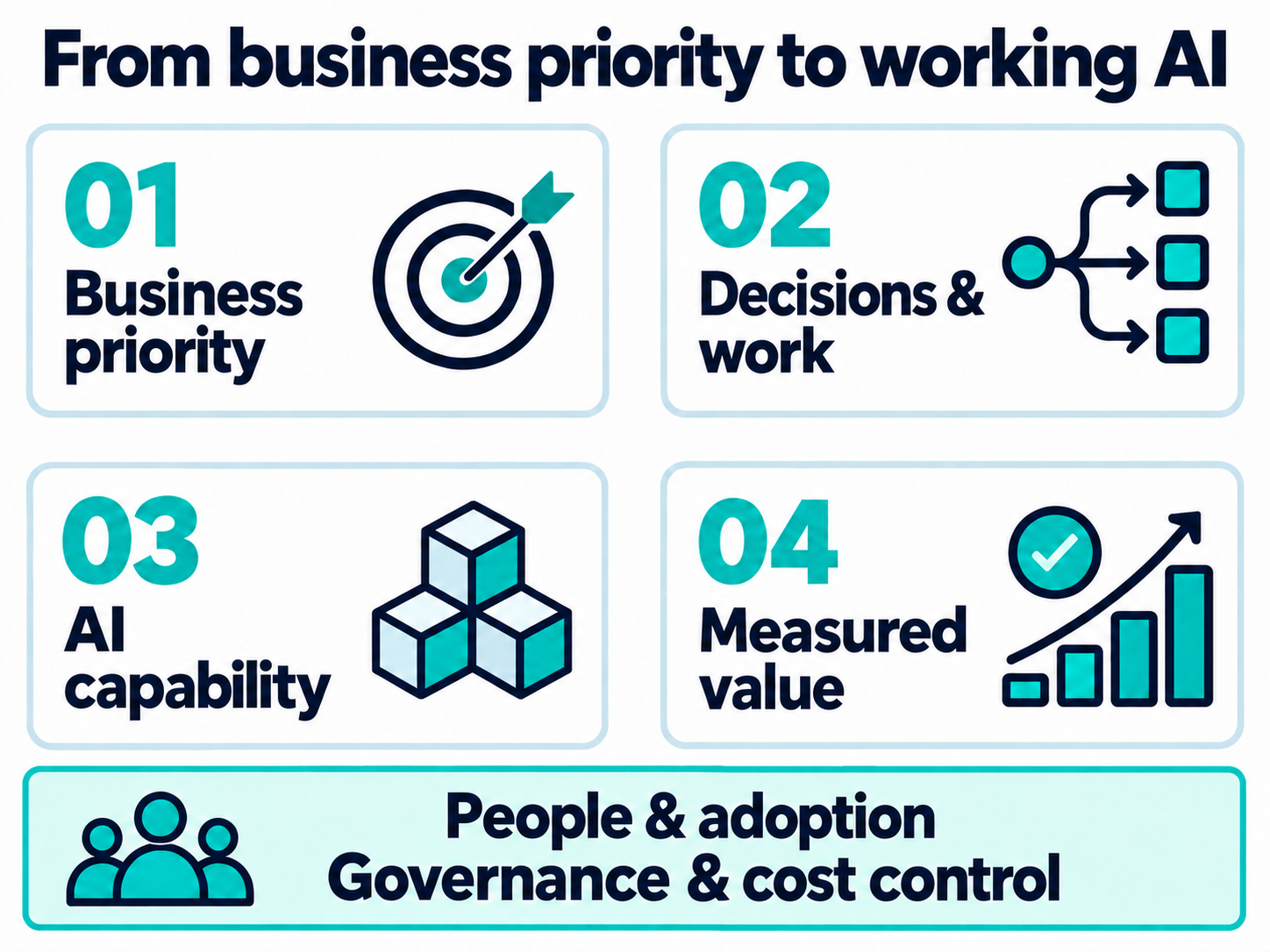
Questions to work through with your leadership partners
What is this AI investment worth?
For business-function sponsors working with CEOs, CFOs and the people preparing their investment cases.
Start with a business outcome and the work that produces it. Establish a baseline, define the unit of value, and examine how adoption, quality, operating cost and risk affect the return. Separate cash savings from capacity released, and measured results from assumptions.
Working outputs: a draft benefit model, a cost-and-value worksheet, an assumptions register, and criteria for funding, scaling or stopping. The aim is a business case a finance leader can interrogate and an accountable owner can update as evidence arrives.
This work draws on the economics, adoption and measurement chapters of Who Approved This? and on Are We Paying Too Much?
Build AI You Can Afford to Scale
For CFOs, business sponsors, CTOs, CIOs and the teams designing or operating AI services.
Your AI budget is being spent one architecture decision at a time: which model answers, how much context it receives, what gets retrieved, what can be cached, and how many steps an agent may take.
We connect those choices to cost per successful business outcome. Examine token consumption, model selection and routing, hybrid retrieval and RAG patterns, caching, retries, tool use and the costs of running the whole workflow. Test the options against the quality, latency and operating requirements the business needs.
Working outputs: a draft consumption and unit-cost model, architecture options and their trade-offs, demand scenarios, a cost-control plan with named owners, and a prioritized set of optimization experiments.
Available as an executive roundtable, a practical workshop or a scoped architecture and operating review. Finance and technology leave with a common basis for deciding what to build, what to change and what to monitor.
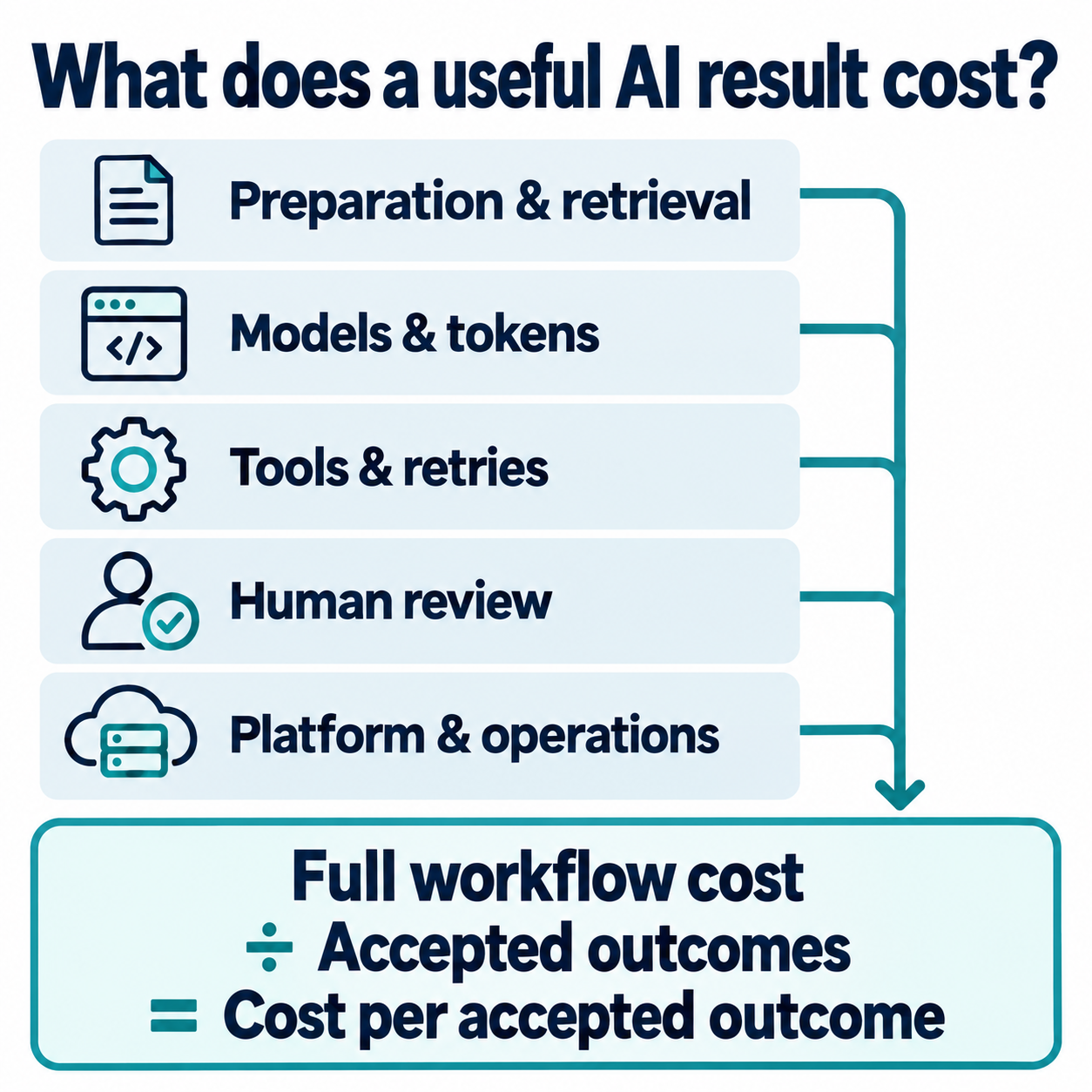
Cost per accepted outcome = full workflow cost ÷ accepted outcomes. Compare the same workload and period at an agreed quality standard.
Who approved this, and what did they accept?
For boards, executive teams, AI leaders and governance functions.
An approval is useful when it records a real choice: who has authority, which trade-offs they accepted, what they need to monitor and what would change the decision. Test whether that authority can act at the speed the system operates.
Working outputs: a draft decision record, a map of decision rights, monitoring responsibilities and reversal triggers. Gaps become specific decisions with owners.
This is the foundation of Who Approved This? and Duly Noted.
How does adoption change the work?
For CHROs, business leaders, transformation teams and the managers responsible for making adoption stick.
Work with the workflow, the people and the incentives around it. Identify which tasks and decisions change, which capabilities each role needs, how managers support application, and what makes the new way of working useful enough to continue.
Working outputs: a workflow and role map, priorities for skilling, an application-based learning plan, and a 90-day adoption plan. Measures connect learning to changed behaviour, decision quality and business outcomes.
Culture becomes visible in everyday choices: whether people can challenge an output, raise a concern, make time to learn, and change a process that no longer fits. Those choices belong in the adoption plan alongside the technology.
This offer combines practical experience with the flagship’s chapters on capability, adoption and measurement.
Choose the format by the outcome
Public speaking and keynotes
For conferences, professional communities and leadership offsites. A focused argument with concrete examples and questions the audience can bring back to work. Typically 30–45 minutes, with optional Q&A.
Topics can centre on moving from AI activity to better business decisions, designing AI that is economical to scale, the business case for AI, the decisions leaders retain as work becomes automated, or the organizational changes needed to turn a pilot into an operating capability.
The value: a shared way to examine the issue and a practical test people can use after the event.
Executive briefings and roundtables
For a business-function leadership team or cross-functional executive group facing a consequential choice. In a 60–90-minute discussion, we examine one investment, architecture choice, deployment, adoption challenge or operating decision. Finance, people, business and technology perspectives meet around the same issue.
The value: trade-offs surfaced, assumptions made explicit, and a concise record of the next decisions and owners.
Practical workshops
Half-day and full-day sessions for the people who must make a decision work. We select a defined use case, agree the working outputs, and identify which business, finance, people, technology, risk and operations roles need to participate.
The value: draft materials the team can continue using, with unresolved questions converted into an owned action plan.
Specialist sessions
From pilot to operating capability
What must be true for a system to run beyond the team that built it? Examine ownership, skills, integration, monitoring, operating costs and fallback arrangements. Produce a readiness assessment and a prioritized implementation backlog.
The Demo Was Flawless
What did it prove about the product you are about to buy? Define an evaluation the buyer controls, test the assumptions behind the claim, and examine dependencies and the cost of leaving. Produce evaluation criteria and a list of evidence required before commitment.
It’s Probably Fine
The service is up. Its decisions are getting worse. Who notices? A talk or incident tabletop on the failures infrastructure dashboards can miss, the authority to contain them, and the fallback a team needs to rehearse.
Who Told It to Do That?
An AI agent can act in your organization’s name. What exactly did you authorize? Apply Scope, Permission, Review to a workflow: what can be delegated, what needs approval, what must stay outside the agent’s authority, and how review keeps pace.
Experience and research behind the sessions
I’m Bandar Alsharfi, also known as Ben. My work connects business goals and the decisions that create value with the technology and operating practices needed to deliver them.
I hold a BSc in Computer Information Systems, an Executive MBA and an MSc in AI Engineering. I have also completed specialized AI certification programmes at MIT and the University of Oxford, and I am a doctoral candidate. Alongside practical delivery and business leadership, I write about the decisions organizations face as AI becomes part of everyday work.
My flagship, Who Approved This? Enterprise AI Governance and the Decisions Nobody Owns, contains 24 chapters and 143 Field Kit tools. Thirteen other books develop the problems around it: buying and funding AI, working across control functions, delegating to agents, and checking the work they produce.
You can also explore the enterprise AI work at Vantage, AI by ntam and the wider ntam Group.
Copies can be arranged for leadership programmes, event attendees or team reading, with a discussion guide connected to the session. Worked cases in the books are composites used for teaching.
Who Approved This? is published across Amazon stores worldwide. Choose your local Amazon store for available editions, pricing and delivery.
Plan a session for your team
Who will be there? What are they trying to decide? What should be different when the session ends?
Send the event or organization, audience, preferred date, location or virtual format, and the outcome you want. Include a budget range and any requirement for attendee books. We can then establish fit and agree the scope, format and fee.
Email info@codedebate.com with your audience, challenge, preferred date, and location or virtual format. We can then agree the right session and scope.

